
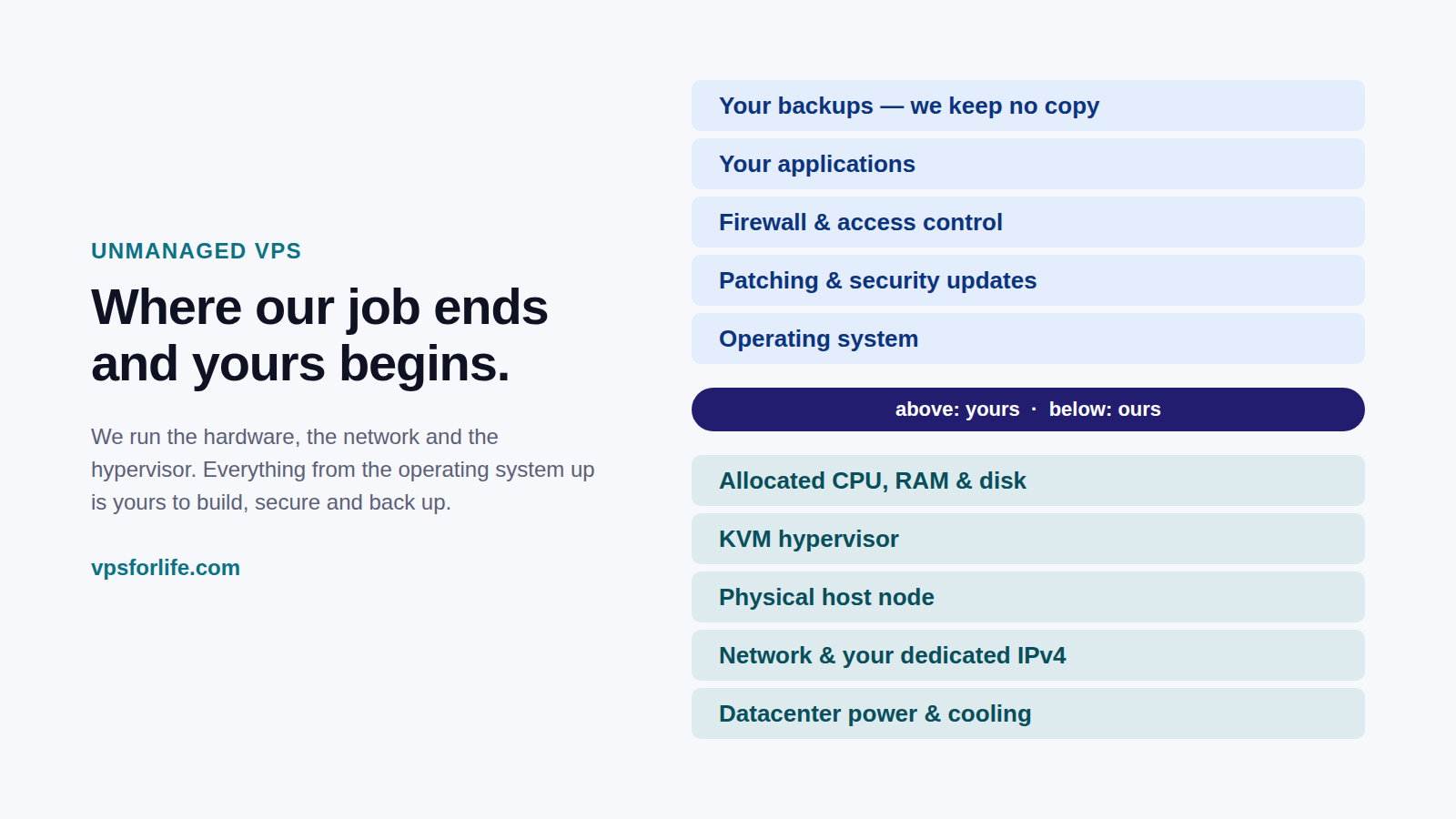
Unmanaged means you are the administrator of your server: you decide which software to install, when to apply updates, and how to configure security. VPS For Life does not access the contents of your server except to investigate a confirmed Acceptable Use Policy violation or a valid legal request, both described in our Terms of Service.
This is the opposite of managed hosting, where the provider's team handles OS patching, application updates, monitoring and (sometimes) security hardening on your behalf — usually for a meaningfully higher monthly price. Unmanaged hosting strips that layer of service out, which is exactly why it costs less: you're paying for the virtual machine, the network, and the dedicated resources, not for a team of sysadmins babysitting it.
In practice, "unmanaged" on VPS For Life means: full root access on Linux (Ubuntu, Debian, AlmaLinux, Rocky Linux) or full administrator access on Windows Server, a clean OS template with nothing pre-installed to fight against, and a support team that will help you get deployed and answer configuration questions — without taking over day-to-day administration of your box.
The single biggest decision when buying a VPS isn't the CPU count — it's whether you want the provider or yourself handling day-to-day administration. Here's the full breakdown.
| Factor | Unmanaged VPS | Managed VPS |
|---|---|---|
| Monthly cost | Lower — no admin labor priced in | Higher — includes provider staff time |
| Who installs software | You, with full root access | Provider, often from an approved list |
| OS & security patching | Your responsibility | Handled by the provider (usually) |
| Control panel | Optional — install one yourself if you want it | Often pre-installed and sometimes mandatory |
| Custom software (Docker, Postal, PowerMTA, etc.) | Fully supported | Often restricted or unsupported |
| Backups | Your responsibility unless the plan says otherwise | Frequently included |
| Response if server misconfigured by you | You fix it, or pay for one-off support | Provider typically fixes it as part of the plan |
| Best for | Developers, sysadmins, agencies, self-hosted software | Non-technical users, businesses without in-house IT |
| Learning curve | Requires basic Linux/Windows admin knowledge | Minimal — provider handles the technical layer |
Unmanaged VPS often gets compared against VDS and dedicated servers too — here's how the resource model differs, independent of the managed/unmanaged question.
| Factor | Unmanaged VPS | VDS | Dedicated Server |
|---|---|---|---|
| What you get | Isolated virtual machine, shared physical host | Same virtualization model, often guaranteed resources | An entire physical server |
| Typical starting cost | From $4.95/month | Similar to VPS pricing | Substantially higher |
| Root/admin access | Full | Full | Full |
| Resource isolation | Dedicated vCPU/RAM allocation via KVM | Same, sometimes marketed as "guaranteed" | Entire machine, no virtualization layer |
| Scaling | Upgrade plan tier in minutes | Upgrade plan tier in minutes | Usually requires a hardware change |
| Good fit for | Most websites, apps, mail servers, dev environments | Same as VPS — see our VPS vs VDS page for the naming nuance | Extremely heavy, sustained workloads or compliance-driven physical isolation — see VPS vs Dedicated Server |
"Unmanaged" is a simple word covering a specific, well-defined split of responsibility. Here's exactly where the line sits on VPS For Life.
| Responsibility | VPS For Life | You |
|---|---|---|
| Physical hardware, power, cooling | ✔ | — |
| Network uptime & connectivity to your VPS | ✔ | — |
| KVM virtualization layer & hypervisor patching | ✔ | — |
| Network-level DDoS filtering | ✔ | — |
| Initial OS deployment (clean template) | ✔ | — |
| Operating system security patches, after deployment | — | ✔ |
| Installing and configuring your application stack | — | ✔ |
| Firewall rules and open ports | — | ✔ |
| Application-level backups | — | ✔ (unless your plan includes daily backup) |
| Monitoring your own services for downtime | — | ✔ |
| Deployment & configuration guidance | ✔ (via support) | — |
| Acceptable use / abuse compliance | Investigates reports — see Abuse Handling Process | ✔ Keeps sending/traffic compliant |
A few concrete profiles where unmanaged hosting is the obvious fit.
Need a clean box to deploy custom stacks, staging environments, or client projects without a control panel in the way.
VPS for Developers →Running MailWizz, Postal or PowerMTA needs Port 25, a dedicated IP and full control over the mail stack.
Email Marketing VPS →Containerized workloads and self-hosted tools need Docker access most managed panels restrict.
VPS for Docker →Want to install their own licensed control panel rather than being locked into the provider's choice.
VPS for cPanel →If none of that sounds like you — if you'd rather not touch a terminal at all — our Managed VPS page is worth reading before you decide.
The first hour on a new unmanaged VPS matters. Here's a sane order of operations.
Since VPS For Life doesn't manage the OS layer for you, these are the practices that matter most on any unmanaged Linux or Windows VPS.
Disable password login once a key-based login works, drastically cutting brute-force risk.
Tools like unattended-upgrades (Debian/Ubuntu) or dnf-automatic (RHEL-based) keep critical patches current without manual babysitting.
Only expose what's actually needed; everything else stays closed at the firewall.
Run web apps and services under a dedicated non-root user, keeping root reserved for admin tasks.
A backup stored only on the same VPS doesn't help if that VPS is compromised or lost — copy critical data off-server.
Even a lightweight log review habit (auth logs, web server logs) catches issues before they escalate.
Our network layer adds its own protection on top of what you configure — see DDoS Protected VPS and Full Root Access VPS for how the responsibility splits at the network edge versus inside your own OS.
Real workloads that specifically need the freedom unmanaged hosting provides.
Every tier below is fully unmanaged, with full root access included as standard.
| Plan | CPU | RAM | Storage | Network Port | Backup | Price |
|---|---|---|---|---|---|---|
| Basic | 1 core | 1 GB | 10 GB SSD | 100 Mbps | — | $4.95/mo |
| Standard | 2 cores | 2 GB | 15 GB SSD | 500 Mbps | ✔ Daily | $9.95/mo |
| Advanced | 4 cores | 4 GB | 20 GB SSD | 1 Gbps | — | $19.95/mo |
| Pro | 8 cores | 8 GB | 25 GB NVMe | 10 Gbps | ✔ Daily | $27.95/mo |
Every plan includes: full root/administrator access, one dedicated IPv4 address, Port 25 access, network-level DDoS filtering, and your choice of Ubuntu, Debian, AlmaLinux, Rocky Linux or Windows Server. See the full hardware specifications for exact detail, or the Pricing page to order.
Unmanaged means you have full root or administrator access and are responsible for ongoing configuration, security updates and backups on your server, rather than the provider handling that layer for you.
It's more suitable for people comfortable with basic server administration; our support team can help with initial deployment questions, but ongoing administration is yours.
Yes, unless your specific plan explicitly includes daily backup (Standard and Pro do), you are responsible for maintaining your own backups.
Yes, full root access means you can install any software compatible with your chosen operating system, with no provider-side allowlist.
Generally yes, since the price does not include ongoing administration, monitoring or patching performed by the provider's staff.
Yes, our team can help with deployment and configuration questions through email or WhatsApp, even on unmanaged plans — see Contact Us.
Since the plan is unmanaged, you're responsible for fixing configuration issues yourself; our support team can offer guidance but doesn't perform ongoing administration on your behalf.
Yes, full root access lets you install any control panel you have a valid license for — see VPS for cPanel and VPS for DirectAdmin.
Not inherently — network-level protections like DDoS filtering are still handled by us. What's on you is OS-level hardening; following the security checklist above covers the essentials.
Our current lineup is unmanaged across all plans; contact sales if your project has specific managed-service requirements to discuss.
Yes, the same unmanaged model applies on our Windows VPS plans — full administrator access via RDP, with ongoing administration in your hands.
Largely naming — see our VPS vs VDS comparison; both typically run on the same KVM virtualization and can be either managed or unmanaged depending on the provider's offering.
Production-grade infrastructure for business-critical unmanaged workloads.
Learn More →Full root access on Linux or Windows, starting at $4.95/month.
View VPS Plans